Image attributed to: Brendan Lynch/Axios, originally in the article posted here.
FWD #253 • 816 words
The Faith in Housing Act Passed Both Chambers — Here’s What Happens Next
Guest author: Briana Paxton, Preservation Maryland
A year ago, we published research showing Virginia’s faith communities own more than 74,000 acres across 22,000 parcels — and that zoning blocked multifamily housing on nearly two-thirds of them in Northern Virginia alone. The question we left open: would lawmakers do anything about it? In 2025, they tried. SB 1178 and HB 2153 both advanced, then stalled. The concept was sound, but the timing wasn’t right.
Maryland is Watching Closely
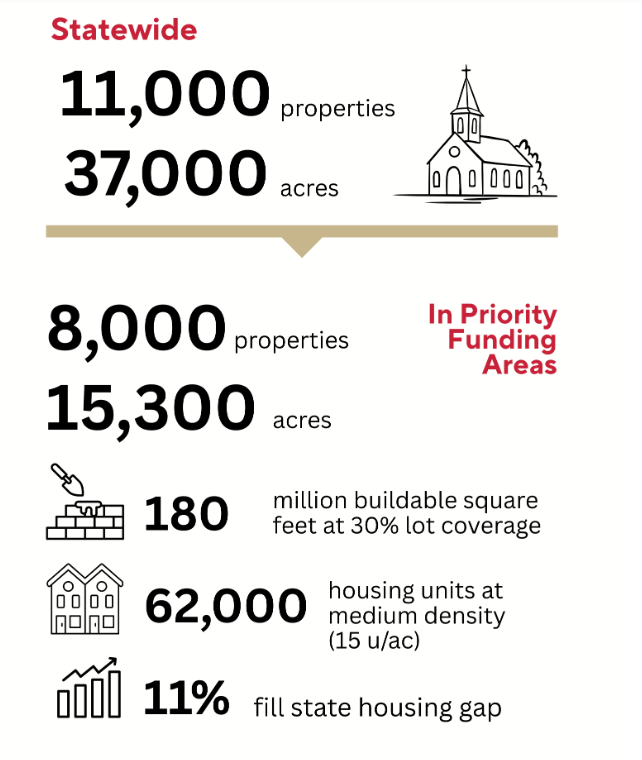
Virginia isn’t alone in asking these questions. Preservation Maryland published its own YIGBY analysis in February, finding over 37,000 acres of faith-owned land in that state — and explicitly pointing to HFV’s Virginia research as a model for how to approach the data.
According to Briana Paxton, a Revitalization Policy Analyst at Preservation Maryland, “Faith communities are significant long-term property owners. Even modest development on a fraction of these sites could create thousands of new homes while helping congregations stabilize their finances and remain anchors in their communities.”
In 2024, Maryland passed a law requiring local jurisdictions to allow a density bonus for affordable housing projects on nonprofit owned land within .75 miles of a rail station. While positive momentum, the provision has had limited impact.
The difference is where each state stands: Maryland is still building the case. Virginia just passed bills in both chambers.
A Bill That Actually Moved…
In February, both chambers of the General Assembly passed legislation to eliminate the rezoning step for faith-based organizations and tax-exempt nonprofits building affordable housing on their properties. The Senate passed SB 388 on a 21-18 vote. The House companion, HB 1279, cleared the floor 60-36 — a notably wider margin.
Passionate testimony from those impacted helped make the case. Reverend Alice Tewell, of the Clarendon Presbyterian Church, testified about the congregation’s long, expensive, and unsuccessful rezoning journey. As cited in a recent article, Tewell testified “We want to build 90 affordable homes for seniors who we heard were living in their cars on our church property five minutes away from the Metro station so people can live with dignity into their golden years. We spent five years and over half a million dollars navigating the process, five years trying to get permission, not building, just waiting.”

The core idea: congregations willing to develop affordable housing shouldn’t have to run a rezoning gauntlet first. By-right approval doesn’t guarantee anything gets built, but it removes one of the biggest procedural obstacles that stalls many projects before they start.
…Albeit with a long horizon
The two versions aren’t identical. The Senate bill sets an effective date of September 1, 2026. The House version, after a committee amendment, would push that to September 1, 2027 — and requires final approval in the 2027 session before it takes effect. That’s a meaningful difference, and reconciling it may carry the bill into next year. While slower, it’s a reminder that Virginia’s housing legislation rarely moves in a straight line.
After this blog was submitted, lawmakers approved a conference committee report with final text based on the Senate substitute. The effective date is January 1, 2027, and a sunset provision sets an expiration date of January 1, 2031. The revised legislation now awaits the Governor’s signature. If made law, the General Assembly will have four years to make these changes permanent.
Why the Zoning Barrier Still Matters
Our 2025 analysis found that across Northern Virginia, multifamily housing is a prohibited use on 65% of faith-owned properties. Alexandria allows apartments on 85% of its faith-owned parcels; many surrounding suburbs permit them on fewer than 15%. A by-right approval process addresses the procedural barrier — but it doesn’t change underlying zoning designations. Jurisdictions with highly restrictive zoning will still effectively limit what can be built, even with streamlined approvals. For a deeper look at how zoning shapes what’s possible for housing at the parcel level, the Virginia Zoning Atlas is a useful starting point.
This year we are looking to further share how zoning impacts development, utilizing the atlas’s data, through our Zoned Out initiative. Get in touch with us if you’d like us to come to your community with this information!
The Federal Piece
Sen. Mark Warner’s federal YIGBY Act, introduced last fall, would layer on top of state-level progress: $50 million per year in grants for communities that remove barriers to faith-based housing development, plus technical assistance for congregations navigating financing and permitting. For Virginia faith communities that want to act but lack development capacity, that last piece may matter as much as anything in the state bill.
What We’re Watching
The by-right approval question is only one part of this. The harder work — connecting willing congregations with development partners, financing tools like LIHTC, and community support — happens outside the legislative process. Our research identified the land. The Faith in Housing Act, if it clears the finish line, removes a key barrier to using it.
Whether Virginia’s congregations can actually get from willing to built is the next chapter.