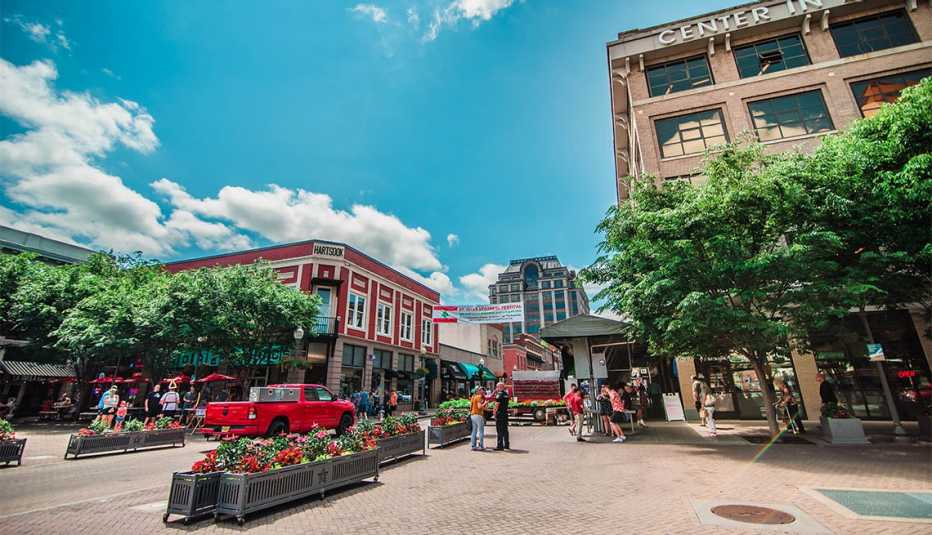
Image: Roanoke City Market
FWD #263 • 869 words
Why street-level variety might matter more than architectural style
There’s something your brain does without asking permission. Every time you walk down a block and something changes — a new door, a different awning, an unexpected color — it sends you a little reward. Neuroscientists call it the orienting response. Urban planner Jan Gehl spent decades counting pedestrians to measure it. His finding? On streets where something new appears every five to seven meters, foot traffic is seven times higher than on monotonous ones. The draw is novelty, not beauty.
That distinction has direct implications for how Virginia communities approach housing and neighborhood design.
The problem with blank walls
Debates over new housing often get stuck on aesthetics: Is this building too plain? Too boxy? Does it fit the neighborhood? These are reasonable instincts. But they often lead to design standards and zoning regulations that target the wrong thing.
Requiring a building to break up its massing, vary its roofline, or add decorative detail doesn’t automatically make a street more livable. What makes a street feel welcoming is variety at the human scale — the sidewalk level, the first floor, the thing you can actually see when you’re walking.
A glass-and-steel box with an active storefront, varied signage, and a couple of entries? That’s often more engaging than a “contextual” brick building with a single entrance and 80 feet of unbroken facade. And research suggests this holds even on quieter residential blocks. It’s the facade detail and ground-floor transparency that move the needle, not the presence of shops or foot traffic. Pedestrians respond to novelty, not style.

What this costs us
This isn’t just a philosophical point. Design requirements that mandate setbacks, specific materials, articulated facades, or stylistic compatibility add real costs — and those costs fall hardest on the projects with the thinnest margins: affordable housing.
When a development is required to redesign a perfectly functional floor plan to add architectural variation that won’t actually improve the pedestrian experience, someone pays for it. The cost might be a longer approval process, a redesign fee, or units that don’t get built at all.
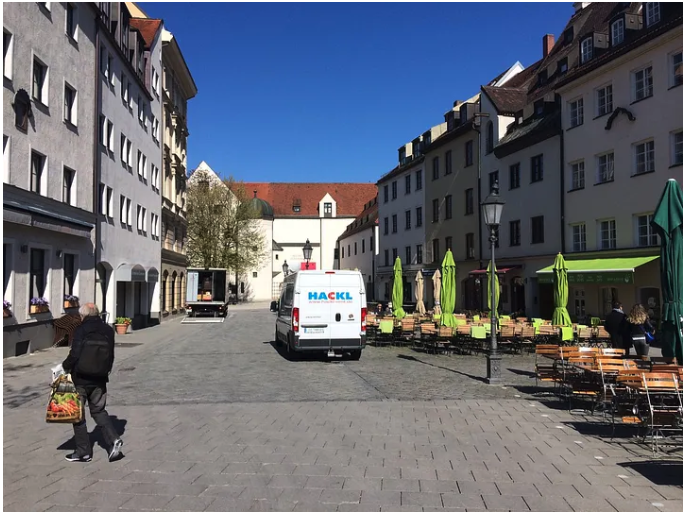
Image source: Mike Eliason, A boxy series of buildings with ground floor variety in Munich
Virginia communities that want more housing — affordable housing especially — should ask whether their design standards are targeting what actually makes a place feel good to live in, or whether they’re optimizing for a visual impression that most residents will only ever see in a rendering.
Rethinking the whole block
The right unit of analysis is the block, not the building. A single architecturally “interesting” building surrounded by parking lots and blank walls doesn’t make a livable street. A block of simple, functional buildings with active ground floors, varied entrances, and small differences in scale and color does.
Surface parking is probably the single most effective street-killer in most throughout Virginia, thanks in large part to minimum parking requirements. A cruel irony can emerge where localities spend months debating facades for buildings that will be separated from the street by a 60-foot parking apron. It’s a Pyrrhic victory at best.
Ground-floor transparency also does more work than a varied roofline ever will. Gehl argues that windows at human scale, transparent facades, and soft transitions between inside and out are what make streets feel safe and inhabited — especially in the evening, when lit windows signal that people are nearby. A building that engages the street at eye level earns that feeling regardless of what’s happening on its upper floors.
That shift has practical implications for where policymakers spend limited political capital. Instead of asking “does this building look right?” local leaders might ask: What’s happening at street level? How many entries does this block have? Is there variety in use — not just in materials?
A different kind of code
Form-based codes are the most direct policy response to these questions. Rather than regulating what a building looks like, they regulate where it sits relative to the street, how the ground floor meets the sidewalk, and where parking is placed. The building’s appearance is largely beside the point.
Virginia has a few examples worth studying. Arlington County’s Columbia Pike corridor adopted a form-based code in 2003 — one of the first applications to an already-developed suburban strip anywhere in the country. Over the following two decades, the corridor added over 1,900 residential units and 210,000 square feet of commercial space, with wider sidewalks and ground-floor retail replacing what had been a car-oriented throughway. The code also helped preserve or replace roughly 1,300 affordable units built with public funds, a feature built directly into its density incentives.
In Fauquier County, a form-based code for the small town of Marshall took a different approach — focused on preserving an existing walkable character rather than creating a new one, and simplifying rules so that more businesses could open by right.
Still, Virginia has been slow to adopt form-based codes relative to peer states, which means most localities continue to rely on conventional design standards to shape what gets built. That could be a gap worth closing.
Good housing policy and good urbanism aren’t in conflict. But they do require being honest about what we’re actually regulating — and what we’re inadvertently making more expensive.