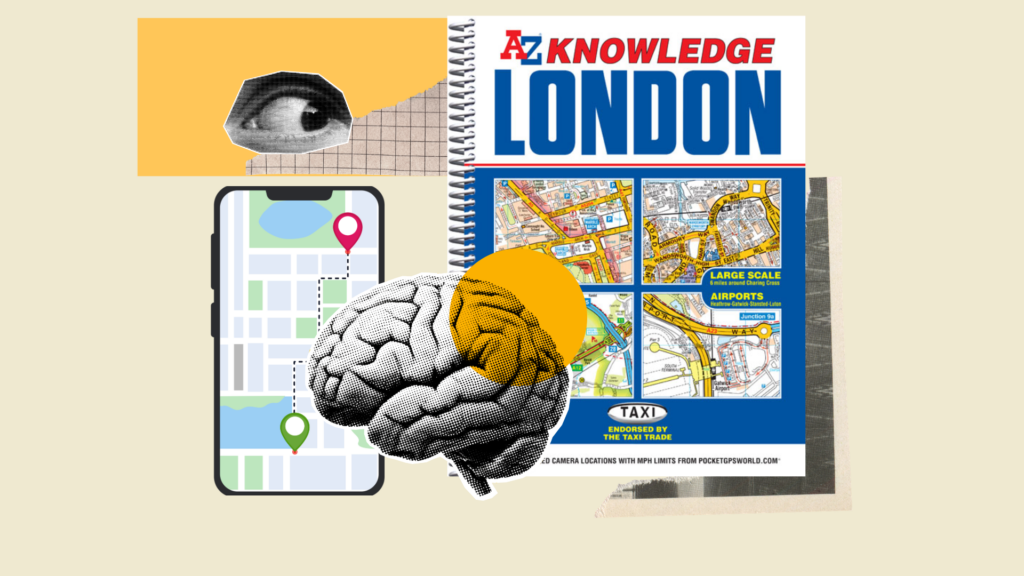
Note: The circled area of the brain in this image is NOT the hippocampus.
THE FWD #274 • 643 words
A 2024 study of 9 million death records found taxi and ambulance drivers have some of the lowest dementia rates of any profession — and the reason might have as much to do with zoning as neuroscience.
Did you know that taxi and ambulance drivers are some of the workers least likely to get dementia? A 2024 study looked at 9 million death records and came up with this conclusion. Those two jobs seem stressful and involve lots of dreaded sitting, so what could they possibly do to stave off a common disease of aging and cognition like dementia?
Maybe it’s all about maxxing that hippocampus, baby. (Someone should really start a YouTube channel called Hippo-Maxxing.) The complex system of streets cabbies often navigate for work isn’t just casual street smarts — it’s a formal, brutal licensing requirement. Before they can pick up a single fare, London cabbies have to pass The Knowledge, a test that requires memorizing roughly 25,000 streets and every landmark along them within six miles of Charing Cross, no GPS allowed. Most drivers spend two to four years studying for it. (The Nudge Podcast has a good rundown of just how grueling that process actually is.) So it’s not exactly a shock that London cabbies have been found to have an enlarged hippocampus, the part of the brain responsible for spatial memory and navigation.
City life comes with another perk: people who live in dense, complex urban areas and navigate them daily also get this spatial-awareness, dementia-fighting benefit.
Allocentric-maxxing
Forget swapping blood with your son — work on your sustained spatial reasoning instead. While still too early to draw conclusions, researchers hypothesize that using allocentric navigation (i.e., directions relative to the earth, independent of the navigator’s orientation) and building cognitive maps can substantially delay diseases like Alzheimer’s or dementia.
Building a cognitive map is a three-dimensional exercise. You create a map independent of your current location and you build it with landmarks, geometric relationships and more. The theory is your brain rotates and assembles sub-maps you have stored as you navigate. Complex urban environments give your brain a reason to do that work every day.
Those GIS Maps Have Another Benefit
Turns out you don’t need to be behind the wheel to get in on this. The theory extends to anyone who works with maps for a living — cartographers, urban planners, and geospatial analysts who layer complex information like demographics and land use onto a neighborhood or city may be firing up those same brain cells.
We’d like to think that includes the team behind our own Virginia Zoning Atlas, built one multi-dimensional map layer at a time and — we’re hypothesizing here — one hippocampus workout at a time. Let that be your balm as you play that eleventh hour of SimCity this weekend.
That road network, though, doesn’t run on GPS or a fixed route — it runs on zoning. A March 2026 study that followed more than 14,000 women for over 30 years found that living in a highly walkable neighborhood in midlife was linked to 17% lower odds of an Alzheimer’s diagnosis later on. Brain scans back it up: a separate 2026 study out of Sydney found older adults in neighborhoods with more connected street grids had a larger hippocampal tail, the part of the hippocampus most responsible for spatial navigation — though that same study found the advantage fades faster with age too, a sign this research is still filling in its edges.
Streets only get that complex, though, if the neighborhood around them is complex too: a mix of housing types, shops, and destinations close enough together to reach on foot. That’s the built environment missing middle housing and zoning reform advocates in Virginia have been pushing for. Turns out the case for building more walkable, complex neighborhoods might be a public health case too.
Unfortunately for Uber drivers, Amazon deliverers, and anyone who habitually pulls up Waze anytime they get in the car, running on fixed routes or using GPS doesn’t generate the same benefits. You’ll have to work out that hippocampus some other way.