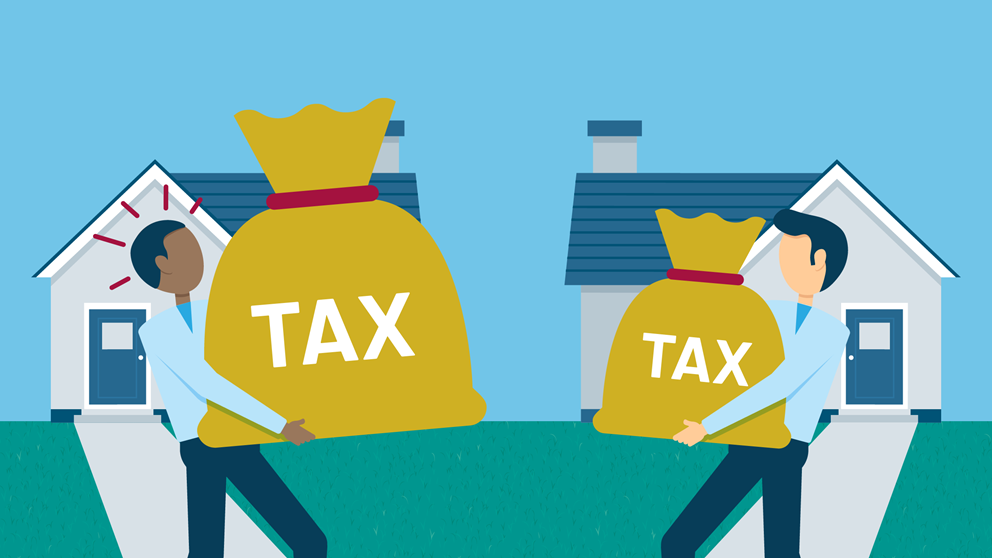
Featured image sourced from The Minneapolis Fed.
The FWD #278 • 1021 words
Part 2 of our property tax series. A growing body of research finds the same pattern almost everywhere: The cheapest homes are over-assessed and the priciest are under-assessed.
Measured against what they’re worth, Richmond’s cheapest homes pay about 1.3 times as much in property taxes as its most expensive. Most Virginia localities do even worse.
Property taxes (which we covered in the FWD#B24) are supposed to be the fair, boring part of local government. You own a home, an assessor estimates what it’s worth, and you pay a rate everyone in your jurisdiction pays. But a wave of research over the past few years has found something strange hiding in plain sight: across nearly every jurisdiction studied, the least expensive homes are assessed too high and the most expensive ones too low. One Harvard law review article put it bluntly — the property tax is premised on repeated determinations that the rich are less rich than they actually are and the less well-off are better off than they actually are. In other words, everyone pays the same rate, but on an inflated value, so the real tax burden lands unevenly.
Researchers have a name for it now: Property Tax Assessment Regressivity (PTAR). The University of Chicago’s Center for Municipal Finance has mapped it nationwide using data on almost 40 million sales, and the pattern holds in all fifty states, where lower-value homes were on average assessed closer to (or above) their market value than higher-value ones. The gap isn’t small. Homes in the cheapest tenth of the market carry a tax burden, relative to their value, more than double what homes in the top tenth pay in the same jurisdiction. In 2017 Detroit, the average bottom-decile home was assessed at three times its actual market value.
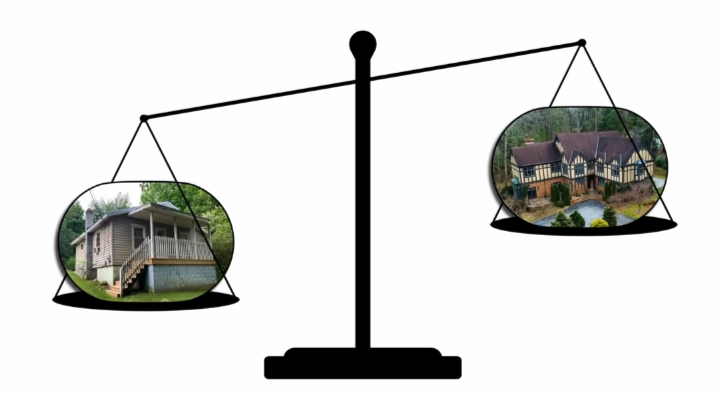
Housing images sourced from the Strong Town video below.
A Mansion, a Modest Home, and the Same Broken Scale
You don’t have to go as far as Detroit to see it. In Buncombe County, North Carolina — home to the city of Asheville — the data firm Urban3 and the Just Accounting for Health consortium dug into all 130,000 parcels and found that lower-valued homes were assessed at a rate about 1.4 times higher than expensive ones. Then came the headline case. Just north of Asheville, the owners of a 14,000-square-foot estate called Deerhaven Gardens listed it for $34 million and said a private appraiser valued it at $40 million. The county had it on the tax rolls at $3.3 million. After the Asheville Citizen Times reported the gap, the county roughly doubled the assessment to $6.3 million — still a fraction of the asking price. The owners’ tax bill went from about $19,000 to about $38,000, and even then they were taxed as if the property were worth a small fraction of what they wanted for it.
Now flip the scale. In the historically Black Shiloh neighborhood, one homeowner saw her modest, decades-old house reassessed with a 91% increase. One 2021 estimate found that poorer homeowners in the county were collectively over-taxed by about $1 million while wealthier ones were under-taxed by nearly $6 million. That’s the whole phenomenon in one county: the mansion pays as if it were a nice house, and the nice house pays as if it were a mansion.
Strong Towns interviewed experts Urban3 about the Asheville research if you’d like to learn more; they also did an entire report on this topic in more depth. Check out their youtube page for more, starting with their overview of this topic embedded below.
What This Looks Like in Virginia
We first flagged the Commonwealth’s version of this inequity in FWD #176. The Chicago data has since been updated through 2024, and Richmond makes the pattern concrete. Across 2014–2024, the city’s least expensive homes were assessed at about 102% of their sale price while the priciest were assessed at 78% — meaning the cheapest homes carry roughly 1.3 times the tax burden of the most expensive, relative to what they’re worth. Translated into a single year, the average bottom-decile Richmond homeowner in 2023 overpaid their fair share by about $245, or nearly 20%, while the average top-decile owner underpaid by about $1,900, or 13%.
Here’s the sobering part for the rest of the state. Richmond ranks 60th of 131 Virginia jurisdictions in the Chicago data — below the midpoint, meaning it’s less regressive than most. More than half of Virginia’s localities show a steeper tilt than the one those Richmond figures describe. The exact numbers vary place to place, but the direction is remarkably consistent: statewide, the lower your home’s value, the larger the share of it you’re likely paying in taxes.
Not a Glitch
It would be easy to write this off as noise. It isn’t. The newest nationwide studies test for random measurement error and still find deep, consistent regressivity underneath it — the pattern shows up whether or not a state caps assessments, and even among homes taxed by the exact same local governments. Why does it happen? Researchers point to the ordinary machinery of assessment: assessors underrate how much a home’s value depends on its specific block, reassess too infrequently to catch shifting values, and run an appeals process that rewards those who use it. Wealthier owners are both more likely to appeal and more likely to win a bigger reduction.
Other research surfaces a racial dimension. Homes owned by Black and Hispanic residents are systematically over-assessed relative to comparable white-owned homes, and about half of that racial assessment gap traces to neighborhood-level misevaluation rather than anything about the house itself. That finding lands in a housing market already marked by deep inequality — the UCLA Civil Rights Project recently underscored that essentially every aspect of housing in America is marked by stark racial inequalities, from homeownership to home equity. An over-assessed tax bill quietly widens that gap, one year at a time.

Further reading: UVA historian Andrew Kahrl’s The Black Tax tells the 150-year story of how local property taxes have stripped wealth from Black homeowners. Kahrl conservatively estimates the cost at more than $275 billion, based on data showing Black and brown neighborhoods are over-assessed by 10–12% compared to white neighborhoods with similar property values.
Sunlight, but Still Skewed
Fixing regressivity is its own project — better data on individual properties, sharper attention to location, more frequent reassessment, a fairer appeals process. It’s distinct from the revenue-raising tax ideas we’ve covered before, like the mansion taxes some states now levy on high-end sales to fund affordable housing. One decides who pays their fair share; the other decides what to do with the money. Both matter, and Virginia currently does little on either.
Here’s the part that should nag at us. Property assessments and sale prices are among the most public records government keeps — anyone can look them up online. An old saying holds that sunlight is the best disinfectant. On property taxes, the sunlight has been streaming in for years, and the least expensive homes on the block are still carrying the heaviest share.