
THE FWD #277 • 1089 words
At our October 14 webinar, the National Zoning Atlas showed where Virginia’s zoning stands next to 18 other states — and Dr. Kathryn Howell shared what Maryland learned once they changed the rules.
Single-family homes are allowed by right on 98.3% of Virginia’s residentially zoned land. Out of 19 states in the National Zoning Atlas, only Hawaii and Utah score higher. Apartment buildings are a different story: homes with four or more units are allowed by right on just 5.4% of that same land.
Those numbers set the stage for our latest webinar, Where Virginia Stands on Zoning Reform: Data, Stories, and Lessons from Peer States. Diana Drogaris, Engagement Director for the National Zoning Atlas and the National Preservation Atlas, brought the national data. Dr. Kathryn Howell, Director of the National Center for Smart Growth at the University of Maryland, brought lessons from next door in Maryland. Missed it?
The National Zoning Atlas reads local zoning codes and puts them on one map you can compare across states. As of October 12, it covers more than 11,700 jurisdictions and 71% of the U.S. population. Diana’s national numbers, paired with our Virginia Zoning Atlas report, show Virginia following the national pattern in most ways. Single-family homes dominate, and lots are big. But the gaps on either side of the average tell the more useful story.
[Editor note: national figures cover the 19 states published to date. The city and suburb comparisons use slightly different samples, so treat them as approximate.]
Where Virginia Does Better
Cities that allow apartments. Charlottesville allows apartments by right on all of its residential land, though a lawsuit has slowed its 2024 rewrite. Roanoke allows them on 70%. Closer to D.C., Alexandria (74%) and Arlington County (72%) land in the same range. Big cities nationally average 25%.
Cities that dropped parking mandates. Charlottesville, Lynchburg, Richmond, and Roanoke require no off-street parking for new homes at all.
A statewide ADU law. Once the new law takes effect in 2027, Virginia joins states like California that require localities to allow ADUs.
Where Virginia Falls Behind
Suburbs that shut out apartments. Virginia’s suburbs allow apartments by right on 1% of residential land, against 9% nationally. Fairfax and Loudoun Counties prohibit them on 88%. Statewide, Virginia ranks 14th of 19 states at 5.4%, under half the national 12%. One in five zoned localities allows no apartments by right anywhere.
Big lots almost everywhere. Ninety-nine percent of Virginia’s single-family land has a minimum lot size, compared with 90% nationally. Nearly a third requires two acres.
ADUs (for now). One-third of Virginia’s single-family land bans ADUs. Northern Virginia is the exception: Loudoun County allows them on all of its single-family land.
Parking outside the cities. Parking mandates cover 93% of Virginia’s residential land. Only 19 localities have none.
Other States Are Using the Data
Diana showed how advocates and lawmakers have used atlas data. In Connecticut, an op-ed with the Parking Reform Network used atlas maps to make the case for parking reform, which passed as part of a larger housing bill HB 8002.
In New Hampshire, atlas data shaped a debate over lot sizes. Researchers at Saint Anselm College found that 93% of the state’s zoning codes ban single-family homes on lots under one acre. A bill to cap minimum lots at one acre stalled in January 2026, but since then voters have indicated they want change. In an August 2026 poll, 74% of residents backed smaller-lot homes in part of every town, up from 59% in 2025. In Virginia, 56% of single-family land requires about an acre or more
Massachusetts’s data gives us a look at how new reforms can struggle to see meaningful impact. Its MBTA Communities Act requires multifamily zoning near transit. About five years in, the atlas found only 1% of land had added multifamily zoning. [Note: the law counts 3+ units; the atlas counts 4+, which could be part of why this number remains low.]
“The Zoning Atlas is meant to be used,” Diana said. You can pull a snapshot for your own region at zoningatlas.org/snapshots or explore the Virginia Zoning Atlas.
What Maryland Learned
We started with a simple question: what’s zoning got to do with it? The answer started with Maryland’s housing gaps.
Nationally, 49% of renters spend more than 30% of their income on housing. In Maryland, it’s more than half. “The rent always eats first,” She said.
The D.C. region has added 175,313 apartments since 2014. Before that, it went more than 40 years without topping 10,000 a year. Inflation-adjusted rents are now falling, though few renters feel it.
Dr. Howell cautioned that households below about 50% AMI will need subsidy “no matter how great your zoning is.”
She then laid out four paths for a region short on housing:
- Blanket upzoning with no protections. New homes ease rents across the region. Some neighborhoods may still see higher rents and pressure to redevelop.
- Doing nothing. Prices rise anyway. “The counterfactual isn’t that no one will come to your neighborhood if you don’t upzone it, Dr. Howell said. People will come, and often current residents get priced out.
- Upzoning with protections. Tools like just-cause eviction and a tenant or county right to purchase keep existing homes affordable while new supply eases rents.
- Market-based upzoning. Localities upzone where demand is highest, even when that’s politically hard. That opens neighborhoods people couldn’t reach before.
Her takeaway: zoning reform works best as one piece of a package.
Maryland’s response spans land use, tenant protections, building design, the approval process, and data. Recent laws allow modular homes wherever single-family homes are allowed and allow denser housing by right near transit. Developers’ rights now also lock in once a project is permitted. In their view, there is no one solution, so turning up all the dials is the only way to see meaningful change.
From the Discussion
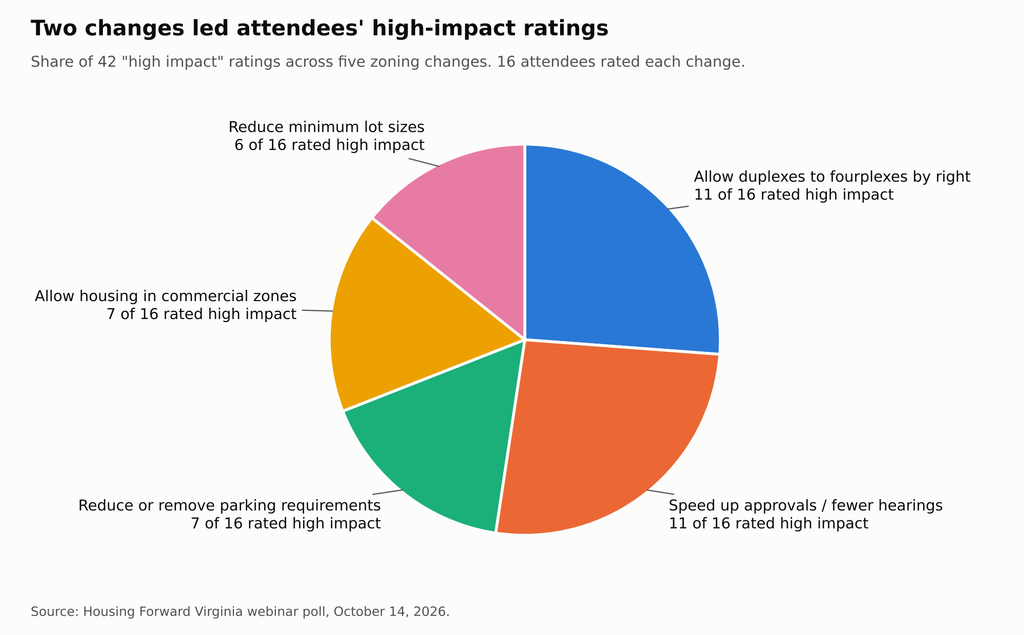
We opened by asking attendees to rate five zoning changes by how much each would expand housing options. Webinar attendees rated allowing duplexes to fourplexes and speeding up approvals as high impact more often than other potential changes.
Passing a law is the first step. In Montana, localities sued or ignored 2024 reforms, Diana said. Small Maryland localities have struggled with the modular law. Dr. Howell’s fix: technical assistance and roadshows that explain the why. That lesson applies to Virginia’s ADU rollout in 2027.
Tenant protections work best statewide. Along Maryland’s Purple Line, rules differ between Montgomery and Prince George’s Counties.
Transit opposition rarely starts with zoning. Dr. Howell pointed to Henrico County, which once refused the Pulse bus line and now talks about extending it. Diana noted that almost no land near Long Island’s commuter rail stations allows dense housing.
Leadership matters. Asked what Richmond could learn, Dr. Howell said leaders have to propose change and stand by it. Even duplexes and quadplexes are a start.
Keep the Conversation Going
Find the recording, slides, and resources here, including the Virginia Zoning Atlas report and our 2026 General Assembly recap.
Have a zoning reform story? Email maria@housingforwardva.org.
Virginia’s cities have shown what reform looks like. The 2027 ADU deadline will test how ready localities are to carry it out.