FWD #249 • 626 words
2025 brought the sharpest federal workforce cuts in decades — and housing agencies weren’t spared.
Federal civilian employment has been shrinking for most of 2025. What started as a wave of early-retirement buyouts and probationary firings in February became, by September, one of the largest single-month separation events in recent federal workforce history. The numbers are now in, and the story isn’t pretty.
A Historic Contraction
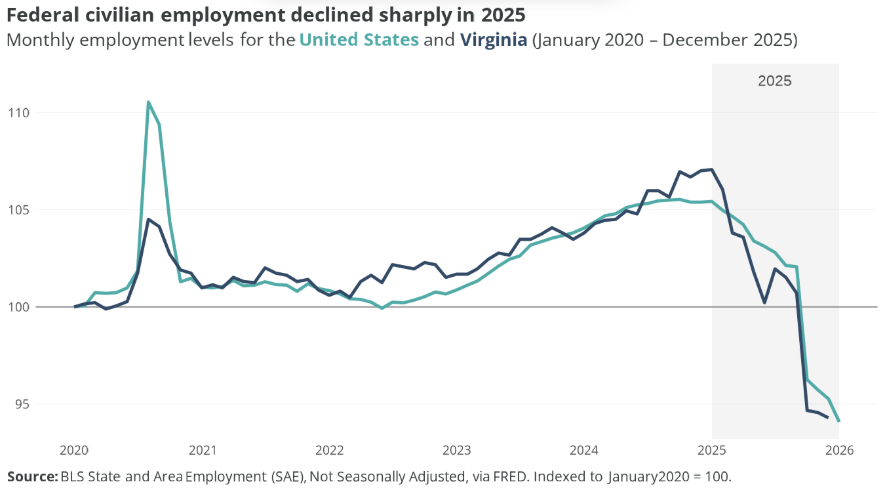
Between January and December 2025, federal civilian employment fell by 9.6% nationwide. Virginia fared worse, dropping 11.9% over the same period — erasing all of the modest growth the state’s federal workforce had accumulated since 2020.
Virginia entered 2025 with about 196,900 federal employees. By December, that figure had fallen to roughly 173,400 — a net loss of more than 23,000 positions in a single year.
The September Spike
The pace of departures wasn’t steady. Through the first half of 2025, workforce numbers fell gradually as early-retirement packages, hiring freezes, and agency-level reductions worked their way through the system. Then September happened.
Of the 5,392 total separations recorded across housing-related agencies* in 2025, some 3,562 — 66% of the annual total — occurred in that single month. Meanwhile, accessions collapsed. Agencies recorded just 318 new hires for the entire year, a ratio of roughly one hire for every 17 departures. The result was less a managed transition than a structural hollowing-out.
* HUD, FHFA, USDA Rural Development, and the CFPB.
Uneven Impacts Across Virginia
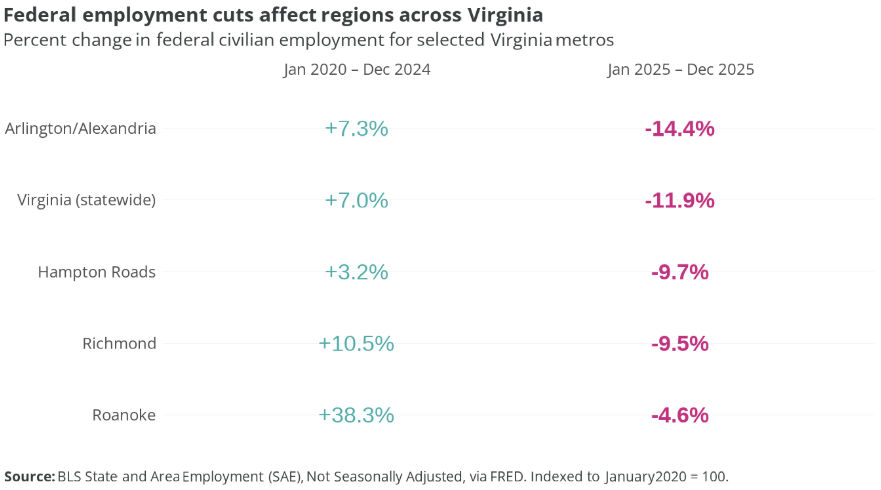
The cuts weren’t evenly distributed. Arlington and Alexandria — home to some of the densest concentrations of federal office workers in the country — saw civilian employment fall 14.4% from January to December 2025, more than any other Virginia region. Hampton Roads, anchored by military installations but also substantial civilian agencies, dropped 9.7%.
The Richmond region fell 9.5%, a figure that might seem unremarkable until you recall the metro spent the prior five years growing its federal employment base by more than 10%.
Roanoke was the outlier. Its federal employment grew significantly over the 2020–2024 period, and its 2025 contraction of 4.6% was smaller than the rest of the state.
Housing Agencies Hit Especially Hard
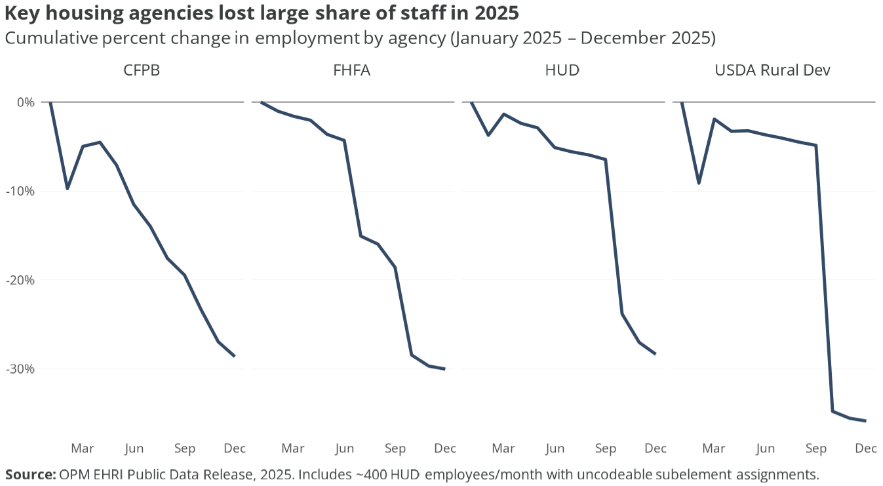
For those working in housing policy and finance, the agency-level data is the most consequential part of this story.
HUD lost 28% of its workforce — from 8,791 employees in January to 6,299 by December. The Federal Housing Finance Agency (FHFA) fell 30%, the Consumer Financial Protection Bureau (CFPB) 29%, and USDA Rural Development 36%. Together, these four agencies lost nearly 4,000 positions in a year.
It will be challenging to thoroughly quantify how reduced staffing levels have translated directly into slower program delivery, delayed grant disbursements, or weakened oversight. But there’s no real precedent for federal housing programs operating with 30% fewer people.
The Experience Problem
Perhaps the least visible consequence is also one of the most lasting. Workers who departed in 2025 had a median tenure of 12.1 years. Those who remained averaged 14.7 years — a gap that doesn’t fully capture what left the building.
The separation profile was bimodal: both early-career workers (under two years of service) and those approaching retirement (ages 55–64) departed at elevated rates. That pattern strips agencies of their junior capacity and their senior expertise at the same time — the people who know how systems work, and the people who are still learning.
What Comes Next
Significant uncertainty remains about how fully these agencies will function going forward, whether cuts will deepen, and how much of this will survive legal challenges still working through the courts.
What the data does show is that 2025 marked a genuine structural break in federal employment. This sustained reduction has reshaped agencies responsible for much of the country’s housing infrastructure. Virginia felt that more acutely than most states.