
Over the past year, we worked across the Commonwealth to help communities large and small solve their housing challenges—from the Blue Ridge to the Tidewater. Here’s a look at what kept us busy.
A Zoning Atlas for the Whole Commonwealth
After nearly three years of effort, the Virginia Zoning Atlas is complete. Every jurisdiction in Virginia has been mapped and analyzed for its zoning regulations related to housing.
Why does this matter? Zoning is often the invisible hand shaping where housing can—or can’t—be built. By joining the National Zoning Atlas initiative back in 2023, we committed to translating the patchwork of local zoning codes into a standardized format that makes it easier to see the big picture.
Now, anyone can explore how different communities treat housing types from single-family homes to duplexes, townhomes, and apartments. In 2026, we’re putting this data to work through our new ZONED OUT initiative, helping localities cut through the “red tape” that slows down housing production.
Building Tools for Uncertain Times
This year demanded new resources to help Virginians navigate a rapidly shifting landscape.
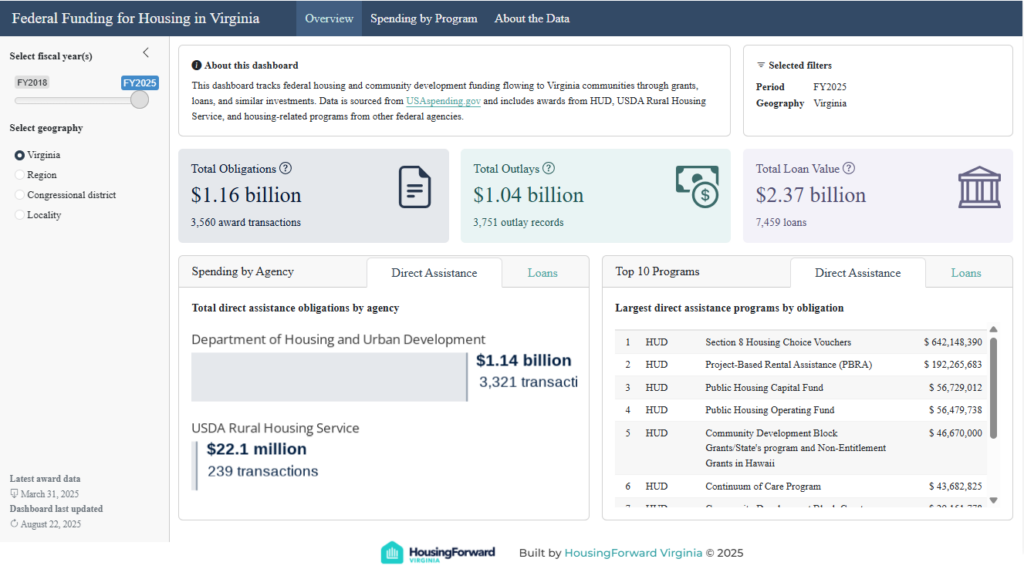
Federal Spending Dashboard: We launched an interactive tool tracking federal housing investments in Virginia—from HUD grants to USDA Rural Housing Service loans. Using data from USAspending.gov, the dashboard shows where federal dollars are flowing, which programs are most active, and how spending has changed over time.
Federal Housing Policy Tracker: In partnership with the Virginia Housing Alliance, we built a digital tracker to monitor federal housing policy changes. It’s designed as a simple, sortable resource that consolidates executive orders, department directives, and other federal actions affecting housing—organized by date, status, and linked to source documentation.
Preservation Dashboard (Coming 2026): Nearly 20,000 LIHTC units in Virginia could lose their affordability restrictions by 2030. We’ve been developing a new dashboard to help identify at-risk properties before it’s too late. Working with the Virginia Affordable Housing Preservation Coalition, the tool will color-code properties by risk level and support emerging state policies aimed at preserving affordable housing.
Ideas Worth Importing
Our webinars brought national voices and innovative ideas directly to Virginia’s housing community, sharing ideas we think could be worth exploring in the Commonwealth.
In July, “Rise of the Enterprise” brought together leaders from Atlanta, Chattanooga, and Chicago to discuss how cities are using public development models to build affordable housing without relying solely on tax credits. Representatives from each city shared their journeys—from building political will to navigating market conditions.
Then in October, “Beds Over Books” explored an unconventional partnership: co-locating affordable housing above public libraries. Panelists from Brooklyn’s Fifth Avenue Committee and the Boston Public Library discussed how these projects maximize public land, create vibrant neighborhood anchors, and address two challenges at once.
Zoning for Abundance
At the 2025 Virginia Governor’s Housing Conference, we hosted the opening plenary session featuring Eric Kronberg—known in planning circles as the “zoning whisperer.” Drawing on his work with the Incremental Development Alliance, Kronberg shared practical strategies for making zoning codes work for housing, not against it.
The session covered everything from building a “housing ladder” that supports residents at different income levels to balancing increased housing options with infrastructure costs. The takeaway? Smarter, incremental code reform can unlock housing attainability without sacrificing community character.
Rolling Up Our Sleeves Across Virginia
Our regional housing assessments continued at full speed. Working with Virginia Tech and local planning district commissions, we helped complete studies for Central Shenandoah PDC, Southside PDC, and began work in the Crater PDC and Thomas Jefferson PDC regions. In all, 36 different localities are included in these assessments—providing the foundation for new policies and programs to support affordable housing.
Common themes emerged across regions: reforming zoning to allow more housing types, supporting homeownership through community land trusts, revitalizing historic buildings for housing, and identifying local funding sources to supplement state and federal dollars.
What’s Ahead
As we look toward 2026, we’re excited to put our research and tools to work. The ZONED OUT initiative will take the Virginia Zoning Atlas findings into communities ready to rethink their approach to land use. The Preservation Dashboard will launch publicly. And we’ll continue bringing expertise and fresh perspectives to Virginia’s housing conversation.
We can’t be everywhere at once, but if you’d like us to talk about housing in your community, drop us a note. Let’s keep working together so we can look back on even greater achievements one year from now.
Want to explore our data tools? Visit housingforwardva.org for the Virginia Zoning Atlas, Sourcebook, and more.