
The FWD #B23 • 1199 words
How Continuums of Care collaborate, coordinate, and commit to end homelessness
Every Virginia community faces homelessness differently. Rural Southwest Virginia’s challenges look nothing like Northern Virginia’s, and what works in Richmond might not fit Hampton Roads. That’s exactly why the federal government doesn’t use a one-size-fits-all approach.
This week, we break down how local Continuums of Care (CoCs) combat homelessness and why this critical system faces unprecedented turmoil. Think of them as regional teamwork hubs where local governments, nonprofits, and service providers coordinate their efforts to prevent and end homelessness.
Here in the Commonwealth, we have sixteen CoCs. Each of those covers a specific region except for the Balance of State (BoS) CoC. Managed by DHCD as the lead agency, the BoS comprises twelve “Local Planning Groups” across non-metro areas.
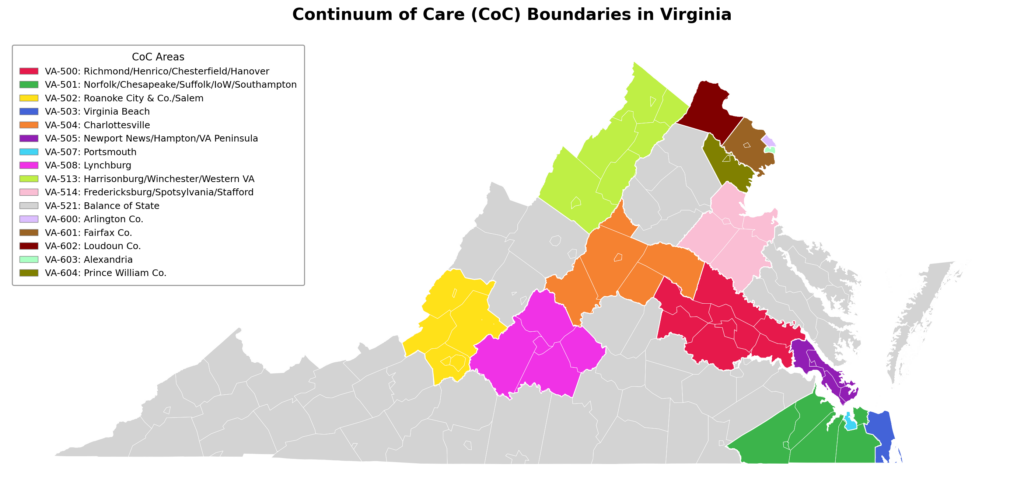
How CoCs Work
Since their creation in 1994, CoCs have worked to bring everyone to the same table. Shelters, rapid rehousing programs, permanent supportive housing providers, outreach teams can all coordinate through their local CoC for local homeless response efforts. The objective is to prevent unhoused people from bouncing between disconnected services or falling through the cracks.
CoCs handle the nuts and bolts of the homeless response system. They maintain a real-time list of available beds and housing units across programs in the region. They decide which programming get priority funding based on the needs of the community and efficacy of services. They collect data on who’s being served and what’s working. And critically, they develop the strategic plan for how their region will prevent and end homelessness.
The CoC structure creates opportunities for innovation. When the Greater Richmond CoC launches new programs to serve young people experiencing homelessness, other Virginia communities can learn from their outcomes. When Hampton Roads develops better coordinated entry systems, those lessons spread. HUD’s traditional emphasis on coordination and evidence-based practices means communities aren’t reinventing the wheel: they’re building on what works.
Where The Feds Come In
The U.S. Department of Housing and Urban Development (HUD) provides CoCs competitive funding that rewards communities for smart, collaborative approaches to addressing homelessness. HUD evaluates these applications based on how well the CoC coordinates services, prioritizes those with the highest needs, and their track record of moving people into permanent housing.
The funding itself supports a range of interventions. Rapid rehousing (RRH) helps families get into apartments quickly with short-term rental assistance. Permanent supportive housing (PSH) connects those with disabilities or chronic health conditions to long term services and affordable housing. Street outreach teams connect directly with the unsheltered, and transitional housing provides a temporary landing spot while someone works toward permanent stability.
But HUD’s role goes beyond writing checks. The department also sets performance standards and expects results. CoCs must report detailed data through the Homeless Management Information System (HMIS), tracking everything from the length of someone’s stay in shelter to how many maintain housing after a year. This accountability pushes communities to focus on outcomes, not just outputs.
Continuum of Care reports
HUD publishes annual reports using data submitted by CoCs, including the critical Point-in-Time (PIT) counts that determine the scope of homelessness in each community. Additional reports cover funding amounts, inventories of units and beds, and related measures.Funding Threats and Uncertainty
The CoC system now faces significant uncertainty following a profound shift in the federal government’s approach to homelessness. Last year, providers faced the complete elimination of CoC funding in the Trump administration’s proposed FY2026 budget. However, as proof of the well-recognized impact of these investments, last week’s final T-HUD appropriations bill actually increases CoC funding by nearly 10%.
As advocates and lawmakers worked to preserve future CoC funding in late 2025, HUD released a Notice of Funding Opportunity (NOFO) that marked a significant departure in funding priorities. Notably, the NOFO capped permanent housing investments (PSH and RRH) at just 30% of CoC funding, which would force providers to operate less effective transitional housing services.
According to NLIHC, the CoC program supports roughly 87% of permanent housing solutions across the nation. The proposed changes would force more than 170,000 people, who were otherwise housed and stable, out of PSH units.
The immediate response was swift: facing a lawsuit, HUD withdrew the controversial NOFO minutes before the December hearing. This provided only temporary reprieve and no requirement to award funds. Lawmakers remedied this issue by including language in the new appropriations bill that requires HUD to automatically renew any CoC grants that expire throughout 2026 if the new NOFO has failed to make awards.
Still, HUD has made it clear that if the court order is lifted, they intend to implement a version of their revised NOFO. Details remain unclear as litigation continues, but any major restructuring would create operational challenges for local providers who’ve built programs around long-standing funding streams.
Why This Matters for Virginia
Virginia’s fifteen CoCs, covering areas from the coalfields to the coast, receive tens of millions in HUD funding annually. The National Alliance to End Homelessness estimates that awards under the proposed NOFO would shift more than $28 million away from permanent housing in Virginia—taking away stable homes for over 2,000 people. Cuts of this magnitude could mean shuttering programs, reducing staff, or turning people away from services.
This collaborative system requires stability, so any federal uncertainty has consequences. More than $100 million in national CoC funding expired in January 2026 alone, with additional grants expiring each month after. Virginia’s CoCs are rightfully concerned, as 35% of permanent housing beds in Virginia are funded by the program.
For now, many CoCs have paused their local application processes. As a result, critical grant money remains in limbo, including $13 million for Fairfax County and nearly $10 million for the Richmond region.
What Happens Next
Understanding how Continuums of Care function helps us see the bigger picture of Virginia’s housing safety net. These highly coordinated systems prevent homelessness when possible, and end it quickly when it occurs. Until recently, HUD has reliably provided the resources and accountability framework to make it happen. Protecting that partnership matters for every Virginia community, especially now.
As Virginia grapples with ongoing affordable housing shortages, rising rents, and potential federal funding cuts, the role of CoCs becomes even more critical. CoCs must work hand-in-hand with affordable housing developers, local housing authorities, and other partners in the broader housing ecosystem to effectively prevent homelessness and permanently house the unsheltered.
Want to learn more?
You can check out the National Alliance to End Homelessness for updates on ongoing litigation, visit our Federal Housing Action Trackers hosted by the Virginia Housing Alliance, and connect with your local CoC to see how these partnerships work in your community and what you can do to support their stable funding.Additional Reading:
- National Alliance to End Homelessness. “State and Local Impacts of HUD’s Housing Cuts.” November 2025.
- National Association of Counties. “HUD’s Continuum-of-Care faces program changes and funding uncertainty.” November 2025.
- Community Solutions. “The Impact of HUD’s 2025 NOFO.” December 2025.
- National Low Income Housing Coalition. “Pursuant to Preliminary Court Order, HUD Announces FY24-25 CoC NOFO is Open.” January 2026.
- HUD.gov. “Continuum of Care Program.” Accessed February 2026.