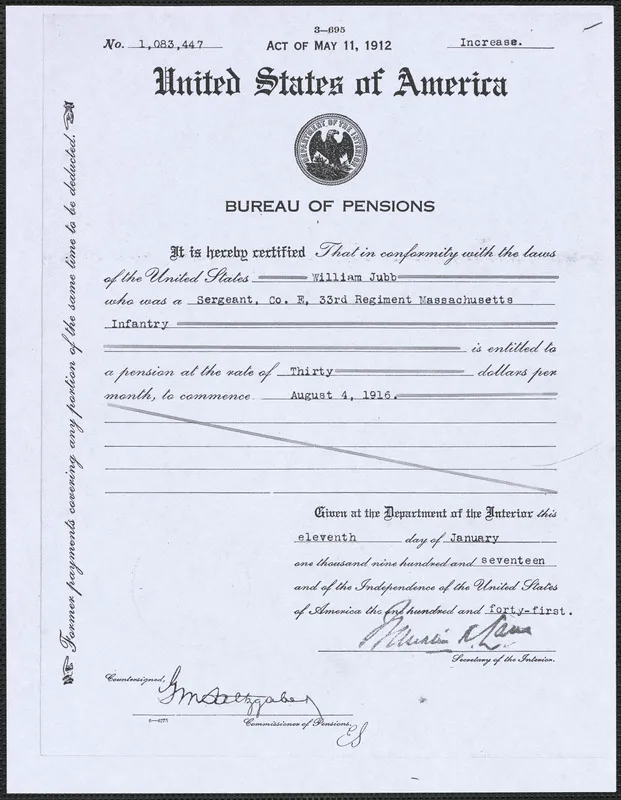
Federal pension document from 1917, J.V. Fletcher Library, 50 Main Street, Westford, Massachusetts 01886
THE FWD #273 • 808 words
What a stack of Civil War pension files can teach us about what to measure now.
A federal bureaucracy that only wanted to verify pension eligibility ended up preserving the only firsthand account of one of the Civil War’s boldest raids. Localities and housing providers are building the same kind of accidental records today.
We’ve been thinking about paperwork this week, thanks to a recent episode of the podcast 99% Invisible. Its new series, A History of the United States in 100 Objects, devoted an installment to an unlikely artifact: a stack of dusty Civil War pension files. It’s ultimately a story about data, so naturally it stuck with us.
How a lowly bureaucracy became a historical archive
After the war, the federal Bureau of Pensions had one narrow job. Was this widow eligible for her husband’s Civil War pension? Answering that question is the reason the testimony of formerly enslaved people survived at all.
Nobody in that office set out to archive Black lives in South Carolina. They set out to process claims. Embedded in that paperwork, however, were full life stories.
When historian Edda Fields-Black wanted to reconstruct the 1863 Combahee River raid—the Harriet Tubman–guided operation that freed more than 700 enslaved people in a single night—she had no surviving firsthand accounts. So she turned to the pension files.
The Black soldiers who carried out that raid had to prove their service to collect what they were owed. Those affidavits became the only surviving records for one of the most daring events of the Civil War.
A few nineteenth century filing cabinets ended up preserving what history books never got around to.
The same accident is still happening today
Neighborhoods in Virginia generate tons of new data constantly. Zillow and MLS listings get scraped daily. Permit offices log every renovation and teardown. Utilities record connections and disconnections. 311 systems record noise complaints, code violations, and trash pileups. Eviction dockets sit in court databases.
None of this was built to document who moved out of a block, whether by choice or by force. But theoretically, a researcher in 2126 could reconstruct displacement trends across a community from this data using the same methods Fields-Black did for the Combahee raid.
The records will continue to outlast the reasons they were created.
What’s already disappearing
While we may be collecting plenty of data, much of it isn’t durably retained. Paper assessor cards might get pulped when an office digitizes. Old single-room-occupancy and rooming-house registries, the paper trail of the cheapest housing a city had, tend to disappear with the buildings. Urban renewal records sit in housing authority basements on a demolition clock.
A growing share of what matters now is born-digital. It lives in a spreadsheet or a on a vendor’s server that nobody has committed to keep past the next software migration. Those Civil War pension files, on the other hand, survived because paper in a federal office is hard to throw away. A CSV file on a former staffer’s laptop is not.
What to record on purpose
This is the part communities can control. If a historian came looking in a hundred years, what would you want on record?
Below are a few examples we think are a good starting point. Some are already part of well-known datasets, but not universally adopted. They apply whether you’re a locality, a housing authority, a nonprofit developer, or a property manager. Let us know if you already track any of it.
Denial reasons: Why an application was denied, not just that it was.
Unit losses, by cause: Why an affordable unit left the stock, not just that it did.
Rent history: What a unit rented for over time, not just its current rent.
Reason for tenant turnover: Whether a household left by eviction, buyout, non-renewal, or choice.
Deciding what to keep
Measurement is a choice about what future memory will contain. Every field an agency decides to keep or skip is a decision about what someone many years in the future will be able to prove.
Which brings us to Minus Hamilton. He was 88 when he watched Union gunboats ascend the Combahee River and lived to see the plantation burn. If it weren’t for some unassuming paperwork created only for someone to check a box about a pension, history would have left him out.
The municipal offices, agencies, and providers in our communities are actively recording the stories of our neighbors and ourselves. But the fragments are scattered across permit portals and court dockets. Our responsibility is deciding, deliberately, what to keep.
So here’s your challenge for the week: pick one field you’re already collecting, and ask what a stranger could reconstruct from it in a century. Then ask what you’d have to add for them to reconstruct the truth.